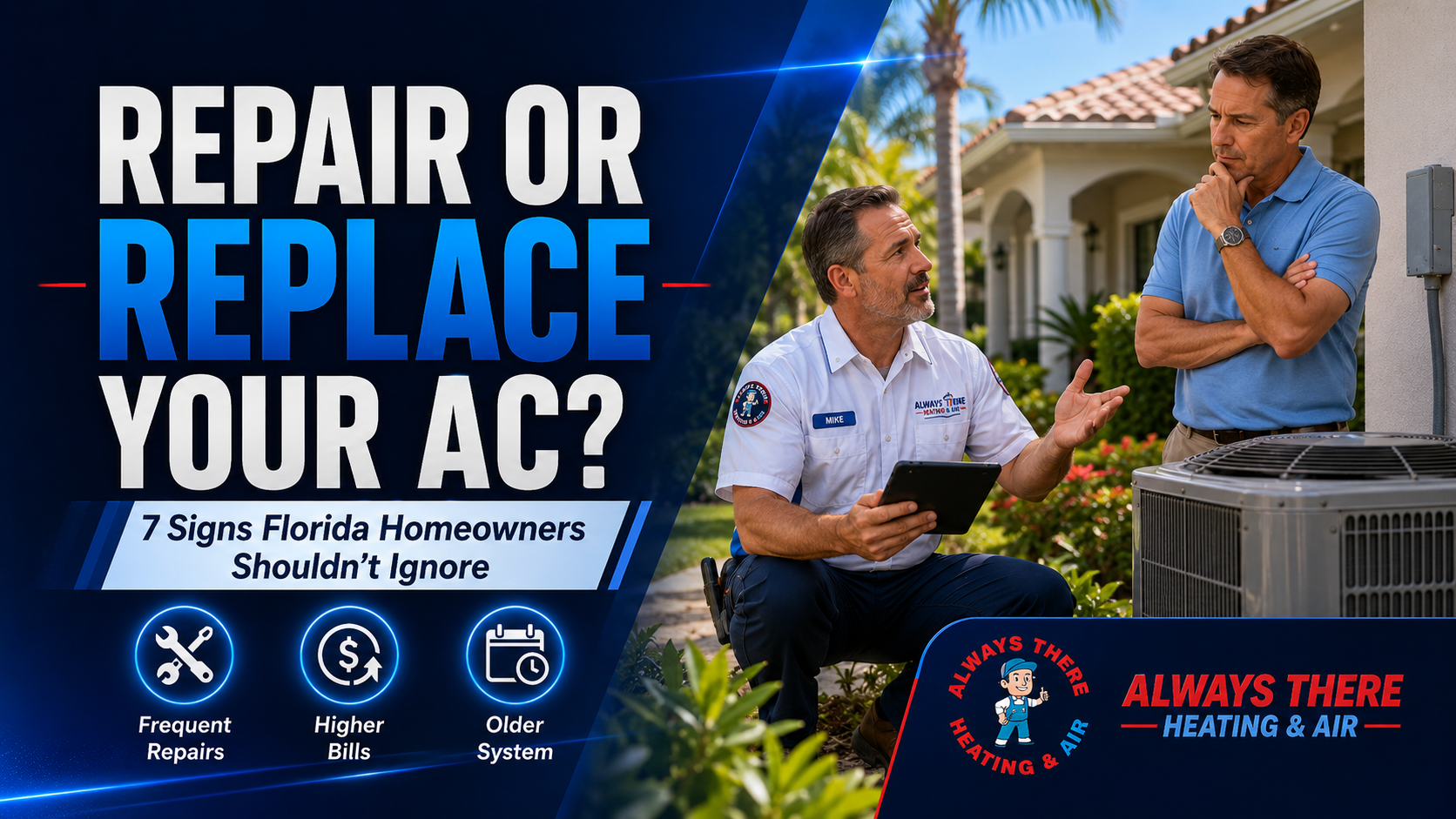
Repair or Replace Your AC? 7 Signs Florida Homeowners Shouldn’t Ignore
When your air conditioner starts acting up, it can be hard to know whether you should invest in another repair or start planning for a replacement.
Helpful HVAC guidance for Florida homeowners.
You should consider replacing your AC if it is 10 to 15 years old, needs frequent repairs, struggles to cool your home, or causes rising energy bills. If the issue is isolated and the system is otherwise reliable, repair may still make sense.
When your air conditioner starts acting up, it can be hard to know whether you should invest in another repair or start planning for a replacement.
For many Florida homeowners, that decision comes down to more than just the current problem. Age, energy efficiency, comfort, repair frequency, and long-term cost all matter. In a hot, humid climate where your AC works hard for most of the year, putting off the right decision can lead to higher bills, uneven cooling, and breakdowns at the worst possible time.
The good news is that there are usually clear warning signs. Here are seven signs Florida homeowners should not ignore when deciding whether to repair or replace an AC system.
Age is one of the biggest indicators that it may be time to move on from your current system.
Most air conditioners can last around 10 to 15 years, but Florida heat and humidity can put more strain on equipment than in milder climates. If your unit is in that range and starting to show signs of wear, every repair becomes a bigger decision.
At a certain point, even a working system may not be operating efficiently enough to justify keeping it. Older units tend to run longer, cool less effectively, and cost more to maintain over time.
One repair does not mean you need a full replacement. But repeated repairs are a different story.
If you have had multiple service calls in the last year, or if you keep fixing one issue only for another one to appear, your AC may be telling you that the system as a whole is wearing out.
This is especially true if the repairs are getting more expensive or your confidence in the system is fading. At some point, continuing to repair an unreliable unit can cost more than putting that money toward a newer, more dependable system.
A sudden or steady rise in your cooling costs is a major red flag.
Sometimes high energy bills are caused by maintenance issues like dirty coils, clogged filters, or reduced airflow. In those situations, a professional tune-up or cleaning may restore efficiency. But when an older system keeps using more electricity while delivering less comfort, replacement becomes a more practical conversation.
This is also a perfect place to mention one of your offers naturally.
If your AC has been running inefficiently, a professional inspection can help determine whether the problem is maintenance-related or a sign of deeper wear. For homeowners who want answers before committing to a major repair or replacement, Always There Heating and Air offers a $69.99 AC inspection and air conditioning cleaning, which can be a smart first step.
If one room feels comfortable but another never cools down, your AC may not be keeping up the way it used to.
Uneven temperatures can point to airflow problems, duct issues, an aging system, or an improperly sized unit. In some cases, the fix is simple. In other cases, it is a sign that your current system is no longer able to cool your home consistently.
Florida homeowners rely on whole-home comfort for more than convenience. Humidity control, sleep quality, and indoor comfort all depend on a system that can perform evenly and reliably.
If your system seems to run nonstop but your home still feels warm or humid, it is a sign that something is off.
An air conditioner that struggles to reach the thermostat setting may be losing efficiency, dealing with airflow restrictions, or nearing the end of its useful life. Constant operation also increases wear on the system, which often leads to more repairs and more stress during peak cooling months.
At this point, the real question is not just whether the system can be repaired. It is whether repairing it still makes sense financially.
If your AC is running all day without keeping your home comfortable, scheduling professional AC repair services can help identify whether the issue is fixable or a sign that replacement may be the better option.
As AC systems age, parts become harder to find and some repairs become less cost-effective.
When a major component fails on an older system, the repair may technically be possible, but that does not always mean it is the best use of your money. If your unit relies on outdated components or is already showing its age across multiple parts, replacement often brings more value than continuing to patch it.
Sometimes the deciding factor is not the current repair bill. It is what you want from your home over the next several years.
If you plan to stay in your home, want more dependable cooling, and are tired of surprise breakdowns, replacing an aging system may be the better move. A newer system can improve comfort, reduce energy waste, and lower the chances of being stuck without AC during the hottest stretch of the Florida summer.
If replacement is the right move, Always There Heating and Air currently offers $1,000 off select HVAC system installations, which can help make the upgrade more affordable while improving your home’s comfort and efficiency.
In general, repair may make sense when:
Replacement may make more sense when:
If you are not sure which path makes the most sense, the best next step is to have the system professionally evaluated. A thorough inspection can help determine whether your AC just needs maintenance, a targeted repair, or a full replacement plan.
For homeowners who want a lower-risk starting point, the $69.99 AC inspection and air conditioning cleaning offer can be a practical way to understand what is going on before deciding on a larger investment.
In Florida, AC issues rarely stay small for long. A unit that is barely holding on in spring can easily become a major emergency in the middle of summer.
Waiting too long can mean:
Taking action early gives you more control over the decision, the timing, and the budget.
The right decision is not always “repair” or always “replace.” It depends on the age of your system, the type of problem, how often issues are happening, and whether the unit is still giving you the comfort and efficiency you need.
If your AC is showing the signs above, Always There Heating and Air can help you make the right call based on your home, your system, and your budget. Whether you need expert AC repair services, a professional inspection, or a full HVAC installation, getting clear answers now can save you frustration later.
And if you are ready to take the next step, do not forget to ask about current specials, including $1,000 off select HVAC system installations and the $69.99 AC inspection and air conditioning cleaning offer.
Look at the system’s age, repair history, cooling performance, and energy efficiency. If the unit is older and problems keep returning, replacement may be the better long-term investment.
Because Florida systems work hard in long cooling seasons, many homeowners begin facing replacement decisions around the 10- to 15-year mark.
Yes. Dirty coils, airflow issues, and neglected maintenance can reduce performance and raise energy bills. That is why an inspection and cleaning is often a smart first step.
In many cases, yes. Replacing a struggling system before a total failure gives you more control over timing, comfort, and budgeting.
Schedule an inspection with Always There Heating & Air to determine what's really causing the problem and which solution makes the most sense for your home and budget.

When your air conditioner starts acting up, it can be hard to know whether you should invest in another repair or start planning for a replacement.

Before summer, homeowners should replace dirty air filters, clear debris around the outdoor unit, check thermostat settings, inspect vents for airflow issues, and schedule a professional AC inspection and cleaning.